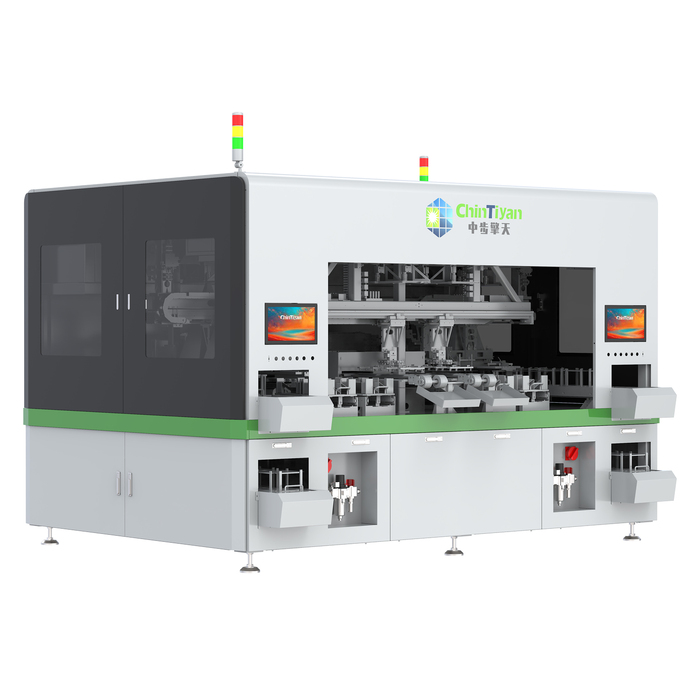
激光劃片機(jī)劃切后電池片邊緣出現(xiàn)毛刺��,是光伏制造過(guò)程中常見(jiàn)的問(wèn)題�����,主要由激光與材料相互作用特性、設(shè)備參數(shù)設(shè)置���、材料特性及工藝控制等因素導(dǎo)致���。以下是詳細(xì)的原因分析及相應(yīng)的解決措施:
Burrs on the edge of battery cells after laser scribing is a common problem in the photovoltaic manufacturing process, mainly caused by factors such as the interaction characteristics between laser and materials, equipment parameter settings, material properties, and process control. The following is a detailed analysis of the causes and corresponding solutions:Cause Analysis
Inappropriate laser parameter settings:
功率過(guò)高:激光功率過(guò)高會(huì)導(dǎo)致材料過(guò)度熔化����,熔化的材料在激光移開(kāi)后迅速凝固���,形成不規(guī)則的邊緣����,即毛刺�����。
Excessive power: Excessively high laser power will cause excessive melting of the material. After the laser moves away, the molten material solidifies quickly, forming irregular edges, i.e., burrs.
脈沖寬度不合適:脈沖寬度過(guò)寬會(huì)使激光能量在材料上作用時(shí)間過(guò)長(zhǎng)����,導(dǎo)致材料過(guò)度受熱和熔化,同樣會(huì)產(chǎn)生毛刺�。
Inappropriate pulse width: An overly wide pulse width will cause the laser energy to act on the material for too long, leading to excessive heating and melting of the material, which also results in burrs.
頻率設(shè)置不合理:頻率過(guò)高可能導(dǎo)致激光能量過(guò)于集中,使材料局部過(guò)熱�;頻率過(guò)低則可能使切割不連續(xù),邊緣不平整。
Unreasonable frequency setting: Too high a frequency may cause excessive concentration of laser energy, resulting in local overheating of the material; too low a frequency may lead to discontinuous cutting and uneven edges.
Inaccurate focus position:
激光焦點(diǎn)未準(zhǔn)確聚焦在電池片表面�����,會(huì)導(dǎo)致切割邊緣能量分布不均����,部分區(qū)域能量過(guò)高產(chǎn)生毛刺,部分區(qū)域能量不足切割不徹底�����。
If the laser focus is not accurately focused on the surface of the battery cell, it will cause uneven energy distribution at the cutting edge. Some areas have excessive energy, resulting in burrs, while other areas have insufficient energy, leading to incomplete cutting.
Improper use of auxiliary gas:
氣體類型選擇錯(cuò)誤:不同材料需要不同的輔助氣體來(lái)輔助切割�����。例如���,切割金屬時(shí)常用氧氣助燃����,而切割非金屬時(shí)可能用氮?dú)饣蚩諝獗Wo(hù)��。選擇錯(cuò)誤的氣體類型會(huì)影響切割質(zhì)量��。
Wrong choice of gas type: Different materials require different auxiliary gases for cutting. For example, oxygen is often used as a combustion aid when cutting metals, while nitrogen or air may be used for protection when cutting non-metals. Choosing the wrong gas type will affect the cutting quality.
氣體壓力不足:輔助氣體壓力不足無(wú)法有效吹走熔化的材料,導(dǎo)致熔化的材料在切割邊緣重新凝固����,形成毛刺��。
Insufficient gas pressure: Insufficient pressure of the auxiliary gas cannot effectively blow away the molten material, causing it to re-solidify at the cutting edge and form burrs.
Material properties:
材料硬度:硬度較高的材料在激光切割時(shí)更難達(dá)到平滑的邊緣�,容易產(chǎn)生毛刺。
Material hardness: Materials with higher hardness are more difficult to achieve smooth edges during laser cutting and are prone to burrs.
材料厚度:厚度較大的材料需要更高的激光功率和更長(zhǎng)的切割時(shí)間���,如果參數(shù)設(shè)置不當(dāng)�����,容易產(chǎn)生毛刺�����。
Material thickness: Thicker materials require higher laser power and longer cutting time. If parameters are not set properly, burrs are likely to occur.
材料內(nèi)部結(jié)構(gòu):材料內(nèi)部存在雜質(zhì)�、裂紋或?qū)訝罱Y(jié)構(gòu)時(shí)�,激光切割時(shí)容易在這些位置產(chǎn)生毛刺。
Internal structure of materials: When there are impurities, cracks, or layered structures inside the material, burrs are likely to occur at these positions during laser cutting.
Equipment accuracy and maintenance:
激光器性能下降:激光器長(zhǎng)時(shí)間使用后�,輸出功率可能下降或光斑質(zhì)量變差,導(dǎo)致切割質(zhì)量下降���。
Deterioration of laser performance: After long-term use of the laser, the output power may decrease or the spot quality may deteriorate, leading to a decline in cutting quality.
光學(xué)元件污染:激光劃片機(jī)中的透鏡���、反射鏡等光學(xué)元件如果被污染或損壞�,會(huì)影響激光的傳輸和聚焦��,導(dǎo)致切割邊緣產(chǎn)生毛刺�����。
Contamination of optical components: If optical components such as lenses and mirrors in the laser scribing machine are contaminated or damaged, it will affect the transmission and focusing of the laser, resulting in burrs on the cutting edge.
機(jī)械部件磨損:設(shè)備中的機(jī)械部件如導(dǎo)軌����、絲杠等磨損后,會(huì)影響切割頭的移動(dòng)精度�����,導(dǎo)致切割邊緣不平整�。
Wear of mechanical components: Wear of mechanical components such as guide rails and lead screws in the equipment will affect the movement accuracy of the cutting head, resulting in uneven cutting edges.
Solutions
Optimize laser parameters:
根據(jù)電池片的材質(zhì)和厚度,通過(guò)實(shí)驗(yàn)確定**的激光功率�����、脈沖寬度和頻率組合�����。
Determine the optimal combination of laser power, pulse width, and frequency through experiments based on the material and thickness of the battery cell.
采用脈沖激光切割時(shí),可以嘗試調(diào)整脈沖形狀和占空比�,以獲得更平滑的切割邊緣。
When using pulsed laser cutting, try adjusting the pulse shape and duty cycle to obtain a smoother cutting edge.
Adjust the focus position:
使用焦點(diǎn)測(cè)試紙或焦距測(cè)量?jī)x準(zhǔn)確確定激光焦點(diǎn)位置�����,并確保切割時(shí)焦點(diǎn)準(zhǔn)確聚焦在電池片表面�。
Use focus test paper or a focal length measuring instrument to accurately determine the laser focus position and ensure that the focus is accurately focused on the surface of the battery cell during cutting.
定期檢查并調(diào)整焦點(diǎn)位置����,以補(bǔ)償設(shè)備磨損或環(huán)境變化帶來(lái)的影響。
Regularly check and adjust the focus position to compensate for the impact of equipment wear or environmental changes.
Reasonably select and use auxiliary gas:
根據(jù)電池片的材質(zhì)選擇合適的輔助氣體類型���。例如��,切割硅基電池片時(shí)常用氮?dú)饣蚩諝庾鳛楸Wo(hù)氣體���。
Select the appropriate type of auxiliary gas according to the material of the battery cell. For example, nitrogen or air is often used as a protective gas when cutting silicon-based battery cells.
調(diào)整輔助氣體的壓力和流量,確保能夠有效地吹走熔化的材料����,防止其在切割邊緣重新凝固����。
Adjust the pressure and flow rate of the auxiliary gas to ensure that the molten material can be effectively blown away and prevented from re-solidifying at the cutting edge.
Strictly control material quality:
對(duì)入廠的電池片進(jìn)行嚴(yán)格的質(zhì)量檢測(cè)���,確保材料硬度��、厚度和內(nèi)部結(jié)構(gòu)符合標(biāo)準(zhǔn)要求�����。
Conduct strict quality inspection on incoming battery cells to ensure that their hardness, thickness, and internal structure meet the standard requirements.
避免使用存在雜質(zhì)�����、裂紋或?qū)訝罱Y(jié)構(gòu)的電池片進(jìn)行激光切割��。
Avoid using battery cells with impurities, cracks, or layered structures for laser cutting.
Strengthen equipment maintenance:
定期對(duì)激光劃片機(jī)進(jìn)行維護(hù)和保養(yǎng)���,包括清潔光學(xué)元件、更換磨損的機(jī)械部件等��。
Regularly maintain the laser scribing machine, including cleaning optical components and replacing worn mechanical parts.
建立設(shè)備維護(hù)檔案����,記錄每次維護(hù)的時(shí)間����、內(nèi)容和更換的部件等信息����,以便追蹤設(shè)備狀態(tài)和預(yù)測(cè)維護(hù)需求。
Establish equipment maintenance files, recording information such as the time, content of each maintenance, and replaced parts, to track equipment status and predict maintenance needs.
Adopt advanced cutting technologies:
考慮采用超快激光切割技術(shù)��,如飛秒激光或皮秒激光��,這些技術(shù)具有更短的脈沖寬度和更高的峰值功率�����,能夠減少熱影響區(qū)��,獲得更平滑的切割邊緣��。
Consider using ultra-fast laser cutting technologies, such as femtosecond or picosecond lasers. These technologies have shorter pulse widths and higher peak powers, which can reduce the heat-affected zone and obtain smoother cutting edges.
探索使用水導(dǎo)激光切割技術(shù)�,該技術(shù)利用水束作為激光傳輸介質(zhì)�,能夠同時(shí)實(shí)現(xiàn)激光切割和冷卻作用,有助于減少毛刺的產(chǎn)生���。
Explore the use of water-guided laser cutting technology, which uses a water jet as the laser transmission medium, enabling both laser cutting and cooling, which helps reduce the generation of burrs.